

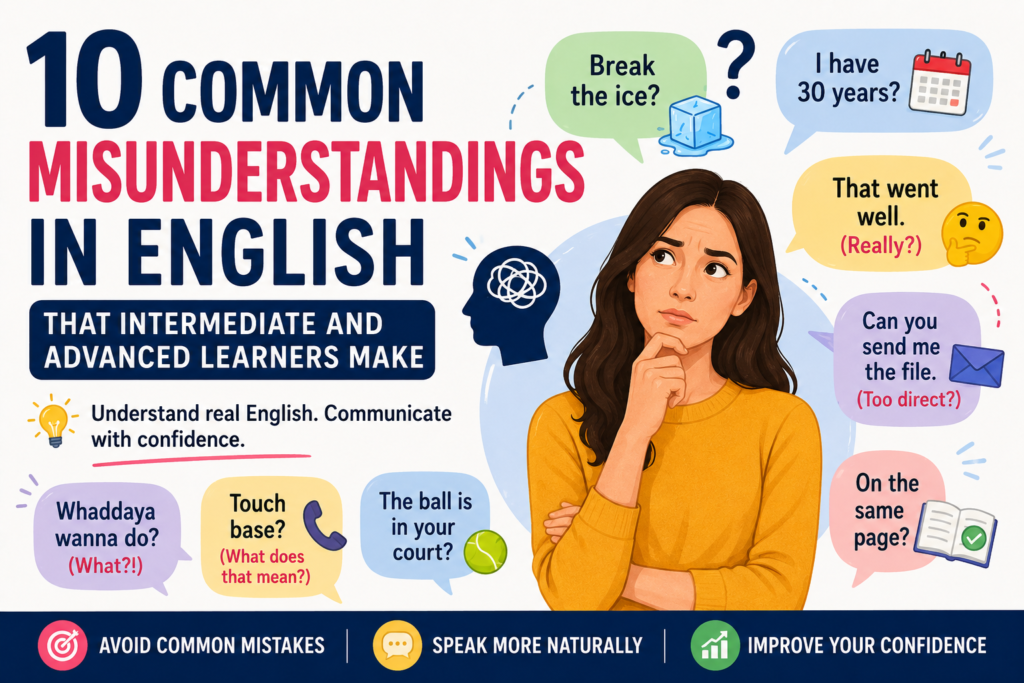
Learning English at an intermediate or advanced level can be challenging. Many learners already know grammar and vocabulary, but misunderstandings in English still happen in real conversations. Sometimes the problem is not the English itself — it is how native speakers actually use the language in everyday situations.
In this article, we’ll look at 10 common misunderstandings English learners often experience, along with examples and simple solutions.
1. Translating Directly from Your Native Language
The Problem
Many learners translate sentences word-for-word from their first language into English.
Example
❌ “I have 30 years.”
✅ “I am 30 years old.”
The Solution
English sentence structure is often different from other languages. Instead of translating directly, learn common English phrases and patterns naturally through listening and reading.
2. Thinking Native Speakers Always Speak Clearly
The Problem
Many learners expect native speakers to pronounce every word perfectly and slowly.
Example
Native speakers may say:
“Whaddaya wanna do?”
instead of:
“What do you want to do?”
The Solution
Listen to real English through podcasts, YouTube videos, movies, and interviews. Learn connected speech and common pronunciation shortcuts.
3. Confusing Polite English with Weak English
The Problem
Some learners think direct English sounds stronger or more professional.
Example
❌ “Send me the file.”
✅ “Could you send me the file, please?”
The Solution
English, especially business English, often uses softer and more polite language. Learning polite phrases improves communication and professionalism.
4. Misunderstanding Idioms Literally
The Problem
Idioms often confuse learners because the words do not match the real meaning.
Example
“Break the ice”
does not mean physically breaking ice. It means starting a conversation comfortably.
The Solution
Learn idioms as complete expressions. Focus on understanding the meaning and situation where they are used.
5. Using Formal English in Casual Situations
The Problem
Many learners study formal textbook English and use it everywhere.
Example
❌ “I am extremely grateful for your assistance.”
✅ “Thanks for your help.”
The Solution
Learn both formal and informal English. Everyday conversations are usually much simpler than textbook examples.
6. Thinking Grammar Is More Important Than Communication
The Problem
Some learners are afraid to speak because they want perfect grammar.
Example
A learner pauses too long trying to choose the perfect tense.
The Solution
Communication is usually more important than perfection. Native speakers often make small grammar mistakes too. Focus on being clear and confident.
7. Misunderstanding Humour and Sarcasm
The Problem
English speakers often use sarcasm, jokes, or indirect humour.
Example
“Well, that went well.”
may actually mean the opposite after a mistake or problem.
The Solution
Pay attention to tone of voice, facial expressions, and context. Watching TV shows and real conversations can help you understand humour better.
8. Using the Wrong Level of Directness
The Problem
Some learners sound too direct or too indirect without realizing it.
Example
❌ “You are wrong.”
✅ “I see your point, but I think…”
The Solution
English speakers often soften disagreement to sound polite and cooperative, especially in business situations.
9. Thinking Vocabulary Alone Creates Fluency
The Problem
Many learners memorize thousands of words but still struggle in conversations.
Example
Knowing the word “negotiate” is useful, but learners also need phrases like:
- “Can we discuss the price?”
- “Would you consider lowering the cost?”
The Solution
Learn vocabulary in phrases, collocations, and real situations — not as isolated words.
10. Expecting to Understand Every Word
The Problem
Many learners panic when they miss one or two words in a conversation.
Example
A learner stops listening after hearing one unknown word.
The Solution
Focus on understanding the general meaning instead of every single word. Native speakers also guess meaning from context.
Final Thoughts About Misunderstandings in English
Misunderstandings in English are a normal part of learning English. Even advanced learners experience communication problems sometimes. The key is to focus on real-world English, common expressions, listening practice, and confidence.
Remember:
- communication matters more than perfection
- context is very important
- English is often more indirect and idiomatic than textbooks suggest
The more real English you hear and use, the more natural your communication will become.