


So, what is an idiom? If you are learning English, you have probably heard expressions that do not make sense when translated word-for-word. For example, if someone says “It’s raining cats and dogs,” they do not mean animals are falling from the sky. They simply mean it is raining heavily. This type of expression is called an idiom.
Idioms are a very important part of everyday English. Native speakers use them in conversations, movies, TV shows, business meetings, social media, and even emails. Learning common idioms can help English learners understand people more easily and sound more natural when speaking.
What Is an Idiom?
An idiom is a group of words with a meaning that is different from the literal meaning of the individual words.
In simple terms, the words together create a special meaning.
For example:
- Break the ice = start a conversation in a friendly way
- Hit the books = study hard
- Under the weather = feeling sick
If you translate these expressions directly into another language, they may sound confusing. That is why idioms can sometimes be difficult for English learners.
Why Are Idioms Used?
Idioms make language more interesting, natural, and expressive. They can help people:
- communicate ideas quickly
- sound more friendly or informal
- add emotion or humour
- create stronger images in conversation
For example, saying:
“I’m very busy”
is correct, but saying:
“I’m snowed under with work”
sounds more natural and expressive in everyday English.
Native speakers often use idioms without thinking about it. Because of this, learning common idioms can improve both your listening and speaking skills.
When Are Idioms Used?
Idioms are commonly used in:
- casual conversations
- business meetings
- movies and TV shows
- social media
- news articles
- podcasts
- workplace communication
Some idioms are informal, while others are suitable for professional situations.
For example:
- Think outside the box is common in business English.
- Costs an arm and a leg is more informal.
English learners should first focus on common idioms that are used regularly in daily life and work situations.
Common English Idioms
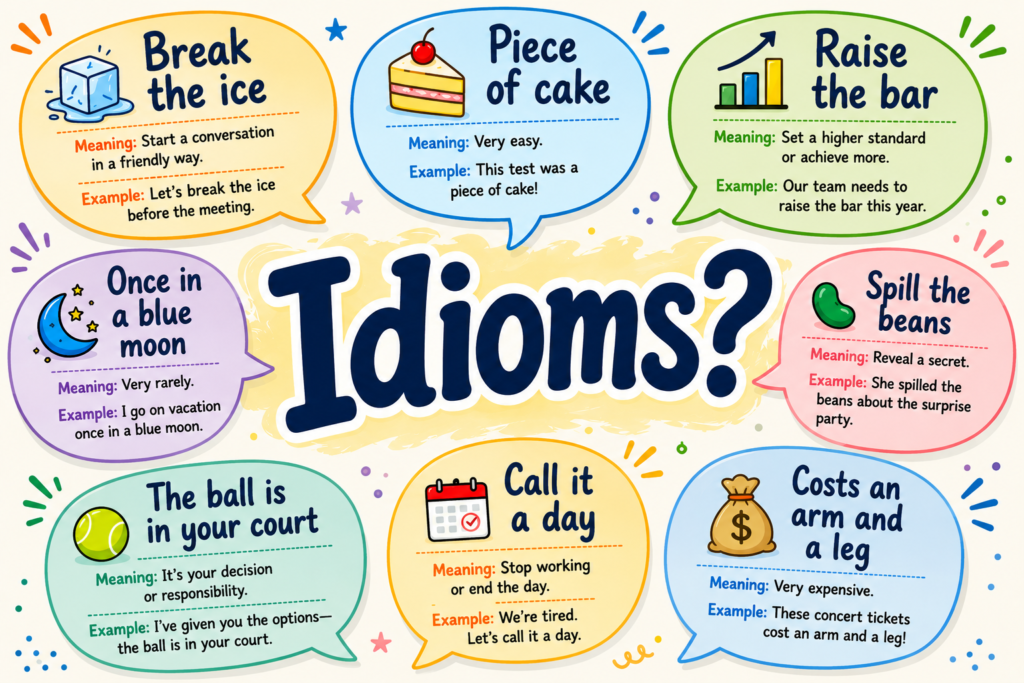
Are Idioms Important for English Learners?
Yes — but learners do not need to memorise hundreds immediately.
It is more useful to:
- learn common idioms slowly
- understand the meaning and context
- listen for them in real conversations
- practise using them naturally
Using too many idioms can sound unnatural, especially if you are unsure how to use them correctly. It is better to learn a few useful idioms well.
Tips for Learning Idioms
Here are some simple ways to improve your understanding of idioms:
- watch English videos with subtitles
- read blog posts and articles
- keep an idiom notebook
- learn idioms by topic (business, travel, meetings, emotions, etc.)
- practise example sentences
- use one new idiom each day
Final Thoughts
Idioms are an essential part of natural English communication. They help conversations sound more fluent, friendly, and expressive. Although idioms may seem confusing at first, learning common expressions step-by-step can greatly improve your confidence in English.
The more you hear and practise idiomatic language, the more natural your English will become.
Learn more Business English and everyday English at BusinessEnglishHub.com