

Small talk idioms are useful expressions that help us start conversations, build connections, and keep them friendly and natural. They are perfect for everyday interactions at work, in social settings, or when meeting new people. Here are 10 common small talk idioms, along with their meanings, and example sentences.
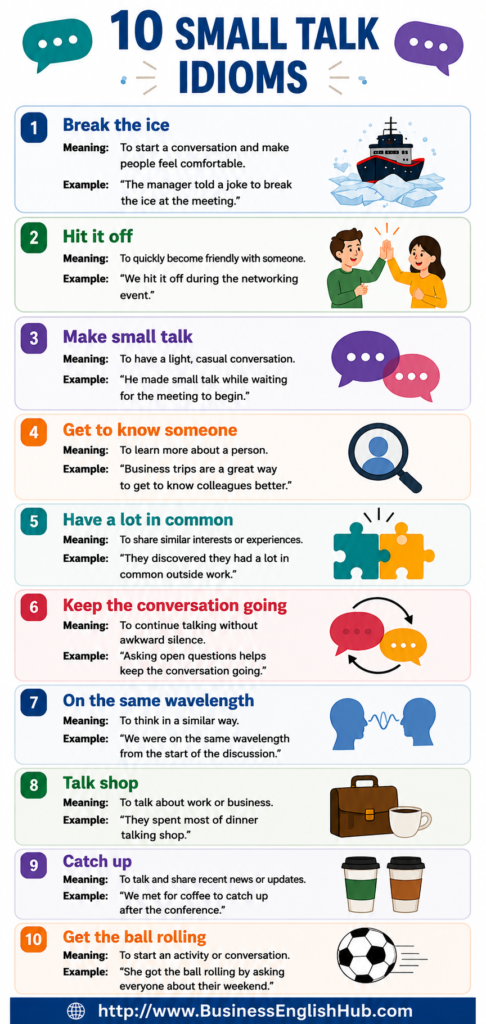
1. Break the ice
Meaning: To start a conversation and make people feel comfortable.
Origin: The idea comes from early 20th-century sailing, where ships would break the ice to start moving.
Example: “The manager told a joke to break the ice at the meeting.”
2. Hit it off
Meaning: To quickly become friendly with someone.
Origin: Baseball term from the 1940s, meaning that a baseball bat connects well with the baseball.
Example: “We hit it off during the networking event.”
3. Make small talk
Meaning: To have a light, casual conversation.
Origin: The phrase has been used since the early 20th century; “small” means polite and unimportant.
Example: “He made small talk while waiting for the meeting to begin.”
4. Get to know someone
Meaning: To learn more about a person.
Origin: Common English expression since the 1600s.
Example: “Business trips are a great way to get to know colleagues better.”
5. Have a lot in common
Meaning: To share similar interests or experiences.
Origin: The phrase has been used since the late 1800s.
Example: “They discovered they had a lot in common outside work.”
6. Keep the conversation going
Meaning: To continue talking without awkward silence.
Origin: Modern English, popular in the mid-20th century.
Example: “Asking open questions helps keep the conversation going.”
7. On the same wavelength
Meaning: To think in a similar way.
Origin: From radio communication in the early 1900s, when devices needed to be on the same wavelength to connect.
Example: “We were on the same wavelength from the start of the discussion.”
8. Talk shop
Meaning: To talk about work or business.
Origin: From the 1920s, referring to a workshop where work matters are discussed.
Example: “They spent most of dinner talking shop.”
9. Catch up
Meaning: To talk and share recent news or updates.
Origin: From horse racing in the 1800s, meaning to reach the same position.
Example: “We met for coffee to catch up after the conference.”
10. Get the ball rolling
Meaning: To start an activity or conversation.
Origin: From sports, especially bowling and football, in the early 1900s.
Example: “She got the ball rolling by asking everyone about their weekend.”
Small talk idioms make our conversations more natural, friendly, and engaging. They help break the ice, build connections, and keep interactions positive, whether in the workplace or in everyday life. Try using these idioms in your conversations and watch your communication skills grow!