

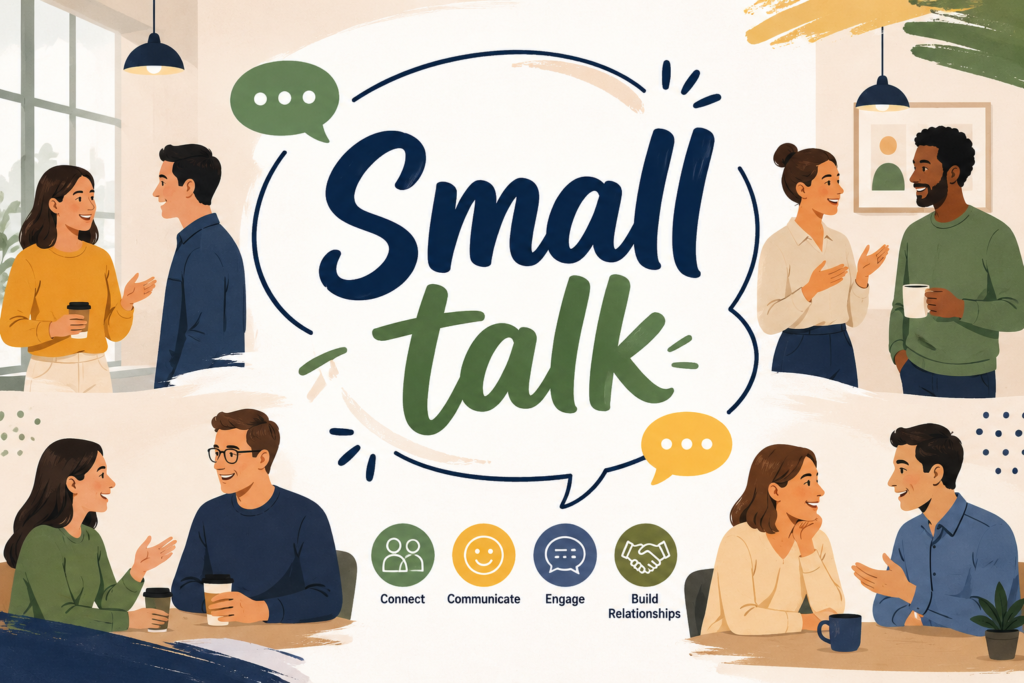
Small talk is one of the most important communication skills in English. Whether you are at work, travelling, networking, attending meetings, or meeting new people, knowing how to make small talk helps you sound more natural and confident.
Many non-native English speakers worry about what to say, how to continue a conversation, or how to avoid awkward silence. The good news is that small talk is not about having deep conversations. It is about creating friendly connections using simple, polite communication.
In this guide, we will answer 10 of the most common questions intermediate English learners ask about small talk, including useful small talk questions, small talk examples, business small talk, and English conversation tips.
1. What is small talk?
Small talk is a short, casual conversation about simple and safe topics. People use small talk to be friendly, polite, and comfortable with each other.
Small talk often happens:
- Before meetings
- At networking events
- In elevators
- While waiting
- During business travel
- At restaurants or conferences
Common small talk topics include:
- Weather
- Travel
- Hobbies
- Work
- Food
- Weekend plans
2. Why is small talk important?
Small talk helps people:
- Build relationships
- Create trust
- Feel comfortable
- Improve networking
- Avoid awkward silence
In business English, strong small talk skills can help you:
- Connect with clients
- Improve teamwork
- Build professional relationships
- Sound more confident in English
Many business professionals say conversations before and after meetings are just as important as the meeting itself.
3. What are the best small talk topics?
The best small talk topics are friendly, positive, and easy to discuss.
Good small talk topics:
- Travel
- Food
- Hobbies
- Movies or TV shows
- Sports
- Weekend plans
- Work projects (light discussion)
- Local events
- Weather
4. How do I start a small talk conversation?
Starting small talk is usually easier than non-native English speakers think. You only need a simple question or comment.
Common conversation starters:
- “Have you been busy lately?”
- “Is this your first time here?”
- “How was your trip?”
- “What do you think of the event so far?”
In business situations, asking open questions helps the conversation continue naturally.
5. What should I say if the conversation becomes awkward?
Awkward silence happens to everyone — even native English speakers.
If the conversation slows down, you can:
- Ask another question.
- Change the topic.
- Comment on your surroundings.
- Use follow-up questions.
Useful phrases:
- “That sounds interesting.”
- “Really? Tell me more.”
- “How did you get into that?”
- “What do you usually do in your free time?”
These phrases help keep the conversation moving naturally.
6. How can I improve my small talk skills?
The best way to improve small talk is through regular practice.
Tips to improve:
- Learn common small talk phrases.
- Watch English interviews or podcasts.
- Practice with coworkers or friends.
- Listen carefully to native speakers.
- Use open questions instead of yes/no questions.
You do not need perfect English to have good conversations. Confidence and friendliness are often more important than grammar.
7. What are common small talk mistakes English learners make?
Many English learners:
- Ask very personal questions too early
- Only answer with short responses
- Translate directly from their native language
- Speak too formally
- Worry too much about mistakes
Example of a weak response:
“Fine.”
Better response:
“Pretty good, thanks. It’s been a busy week at work.”
Longer answers help conversations continue more naturally.
8. What is business small talk?
Business small talk is casual conversation used in professional situations.
It often happens:
- Before meetings
- During networking events
- At conferences
- During business dinners
- While travelling for work
Business small talk examples:
- “How long have you worked in this industry?”
- “How was your flight?”
- “Have you visited Dublin before?”
- “What projects are you working on at the moment?”
Business small talk should sound friendly but professional.
9. How long should small talk last?
Small talk is usually short. Most conversations last:
- 2–10 minutes
- Until a meeting starts
- During breaks or waiting times
The goal is not to have a deep discussion. The goal is to create a positive and comfortable interaction.
Sometimes small talk naturally develops into a longer conversation.
10. What are useful small talk phrases I should learn?
Learning common small talk phrases can make conversations much easier.
Useful small talk phrases:
- “Nice to meet you.”
- “How have you been?”
- “What do you do for work?”
- “That sounds interesting.”
- “I’ve heard great things about that.”
- “How was your weekend?”
- “What brings you here today?”
- “It was great talking to you.”
These phrases are commonly used in both social and professional English conversations.
Final Thoughts on Small Talk
Small talk is an essential skill for English learners, especially for professionals, travellers, and anyone working in international environments. Good small talk helps you build relationships, improve communication, and feel more confident speaking English.
Remember that small talk does not need to be perfect. The goal is simply to connect with people in a friendly and natural way. By learning common small talk phrases, practicing conversation starters, and asking open questions, your English communication skills will improve quickly.
The more you practice small talk, the more comfortable and natural your conversations will become.