
Admin

Do Make Give Had

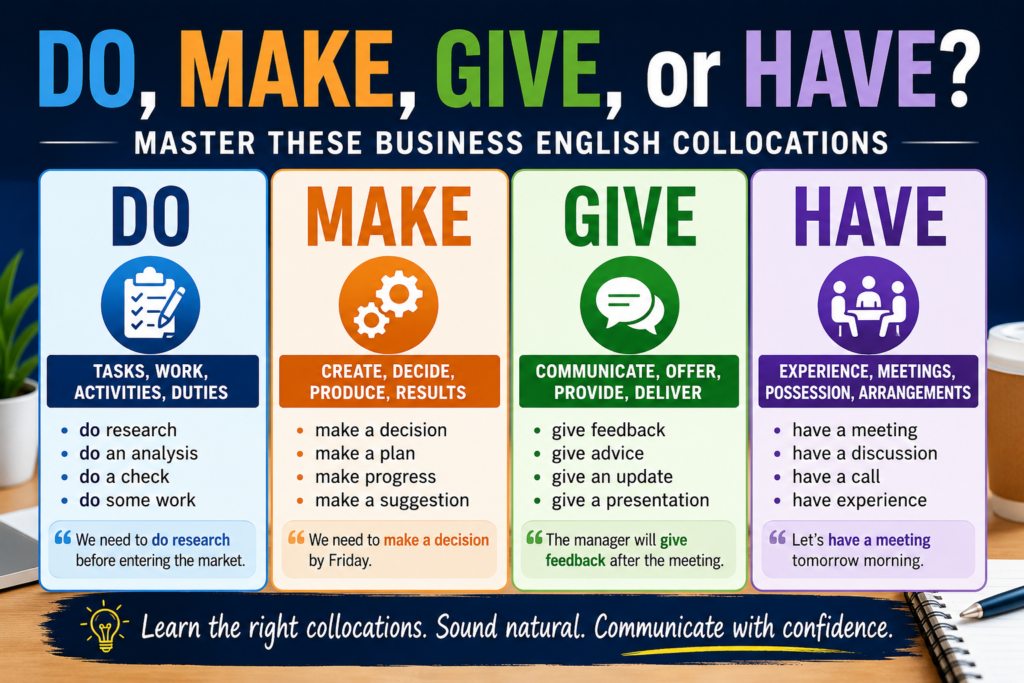
Do, Make, Give, or Have? The Business English Collocations You Need to Know

If you have ever wondered whether you should do research, make a decision, give feedback, or have a meeting, you are not alone. Many non-native English get very confused about when to use Do, Make, Give, or Have. After teaching Business English to students from around the world, I have found that do, make, give, and have are four of the […]

Do, Make, Give, or Have? The Business English Collocations You Need to Know Read More »

Their There or They're

Their, There, OR They’re: Never Confuse These Words Again!

Do you ever stop and wonder whether to write their, there, or they’re? You’re not alone! This is one of the most common mistakes in English. The three words sound the same, but they have completely different meanings and uses. In this guide, you’ll learn the difference between their, there, and they’re, along with simple examples and an easy memory trick

Their, There, OR They’re: Never Confuse These Words Again! Read More »

Business Phrasal Verbs

Communicate Better In English With These Business Phrasal Verbs

Introduction to Business Phrasal Verbs Learning business phrasal verbs is one of the fastest ways to improve your professional English. Native English speakers use phrasal verbs every day in meetings, emails, presentations, and workplace conversations. If you understand and use common business phrasal verbs correctly, you will sound more natural, confident, and professional. In this article, you’ll

Communicate Better In English With These Business Phrasal Verbs Read More »

Soften your English

5 Effective Ways to Soften English in Professional Situations

Introduction In professional conversations, how we communicate can significantly impact our interactions. Softer language can promote a collaborative atmosphere and reduce tensions. This blog post explores five effective ways to soften English, enabling you to convey messages with greater tact and sensitivity. 1. Use Modal Verbs Modal verbs like “could,” “might,” and “would” are powerful

5 Effective Ways to Soften English in Professional Situations Read More »

Its or It's

It’s or Its? A Quick Guide To Learn The Difference

Learning English can be confusing, especially when two words look almost the same. One common mistake is using it’s or its incorrectly. Although they look very similar, they have different meanings and uses. In this guide, you’ll learn the difference between its and it’s, see plenty of examples, and discover a simple trick to help you remember which one to use.

It’s or Its? A Quick Guide To Learn The Difference Read More »

Travel idioms

Travel Idioms You Need to Know for Everyday English and Travel Conversations

Travel idioms are very common in English conversations, business communication, movies, and everyday life. Many of these expressions are used even when people are not actually talking about travel. Learning these idioms can help you sound more natural and understand native English speakers more easily. 1. Hit the Road Meaning To leave or begin a

Travel Idioms You Need to Know for Everyday English and Travel Conversations Read More »

Business idioms

Business Idioms for Professional and Workplace English Conversations

Business idioms are very common in meetings, negotiations, presentations, emails, and workplace conversations. Native English speakers regularly use these expressions in professional situations, so understanding them can help you communicate more naturally and confidently. Learning business idioms can also improve your listening skills and help you sound more fluent at work. 1. Bring to the

Business Idioms for Professional and Workplace English Conversations Read More »

Negotiation idioms

Negotiation Idioms You Need to Know for Business English

Negotiation idioms are very common in business English, meetings, sales conversations, and workplace communication. Native English speakers often use these expressions during discussions, deals, and decision-making situations. Learning negotiation idioms can help you sound more professional, communicate more naturally, and better understand English-speaking colleagues and clients. 1. Meet Someone Halfway Meaning To compromise or accept

Negotiation Idioms You Need to Know for Business English Read More »

Money Idioms

Money Idioms You Need to Know for Everyday and Business English

Money idioms are very common in everyday English, business conversations, movies, and TV shows. Learning these expressions can help you sound more natural and understand native speakers more easily. Below are 10 of the most commonly used money idioms, along with their meanings, origins, and example sentences. 1. Break the Bank Meaning To cost too

Money Idioms You Need to Know for Everyday and Business English Read More »