

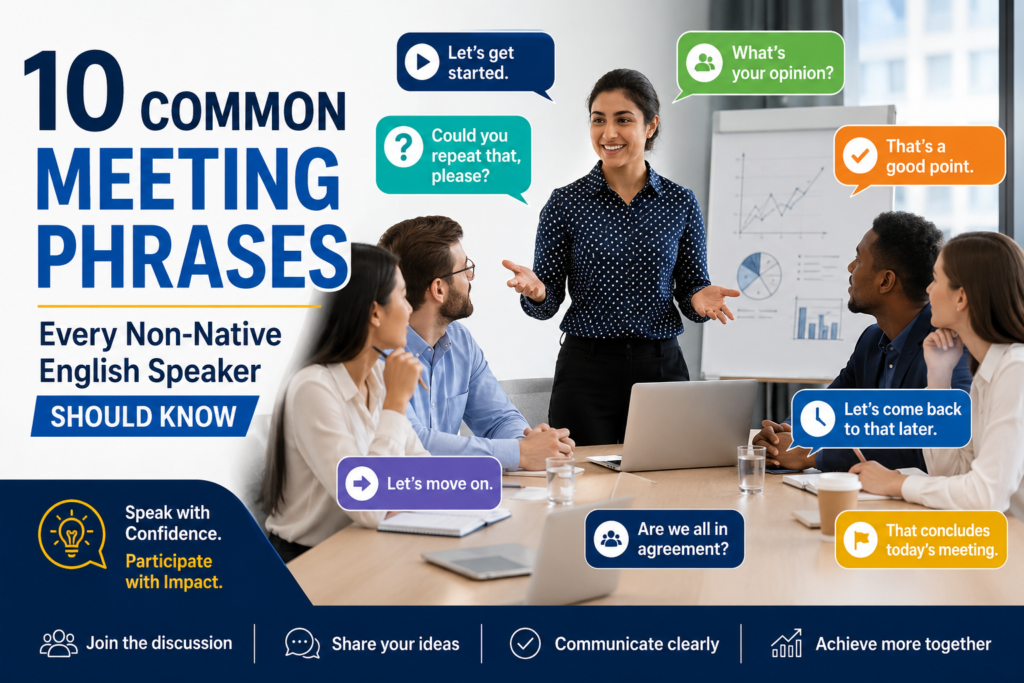
Meetings are an important part of business life. Whether you work in an office or attend online meetings, using the right English meeting phrases can help you communicate clearly and confidently.
Many non-native English speakers know the grammar they need, but they are unsure what native speakers actually say during meetings. Learning a few common meeting phrases can make it much easier to join conversations, share your ideas, and sound more professional.
In this guide, you’ll learn 10 of the most common meeting phrases, what they mean, when to use them, and see real examples from everyday business situations.
1. Let’s get started.
Meaning
A phrase used by the meeting leader to begin the meeting.
Example
Other ways to say it
Manager: “Good morning, everyone. Let’s get started.”
- Shall we begin?
- Let’s begin.
- We’ll get started now.
2. Can everyone hear me?
Meaning
Used at the beginning of online meetings to check that everyone’s audio is working.
Example
Presenter: “Can everyone hear me before we begin?”
Other ways to say it
- Can you hear me?
- Is my microphone working?
- Can everyone see my screen?
3. Let’s move on.
Meaning
Used when changing to the next topic.
Example
“We’ve finished discussing sales. Let’s move on to marketing.”
Other ways to say it
- Let’s continue.
- Next on the agenda…
- Let’s discuss the next point.
4. I’d like to add something.
Meaning
A polite way to join the conversation.
Example
“I’d like to add something about the new project.”
Other ways to say it
- May I add something?
- I’d like to make a point.
- If I may…
5. Could you repeat that, please?
Meaning
Used when you didn’t hear or understand something.
Example
“Sorry, could you repeat that, please?”
Other ways to say it
- Could you say that again?
- Sorry, I missed that.
- Could you explain that again?
6. That’s a good point.
Meaning
Shows that you agree with someone’s idea.
Example
“That’s a good point. We should consider that.”
Other ways to say it
- I agree.
- That’s true.
- I think you’re right.
7. What’s your opinion?
Meaning
Used to invite someone to speak.
Example
“Sarah, what’s your opinion on this proposal?”
Other ways to say it
- What do you think?
- Would you like to add anything?
- Do you have any suggestions?
Your Attractive Heading
8. Let’s come back to that later.
Meaning
Used when a topic should be discussed later.
Example
“That’s important, but let’s come back to that later.”
Other ways to say it
- Let’s discuss that afterwards.
- We’ll return to that.
- Let’s park that for now.
Business Tip: Native speakers often say “Let’s park that for now.” It means “We’ll discuss it later.”
9. Are we all in agreement?
Meaning
Checks whether everyone agrees before making a decision.
Example
“Are we all in agreement on the new budget?”
Other ways to say it
- Does everyone agree?
- Are we happy with this?
- Is everyone okay with that?
10. Thanks, everyone. That concludes today’s meeting.
Meaning
A polite way to finish a meeting.
Example
“Thanks, everyone. That concludes today’s meeting.”
Other ways to say it
- Thanks for your time.
- That’s all for today.
- We’ll finish there.
Quick Summary
| Phrase | When to Use It |
|---|---|
| Let’s get started. | Begin a meeting |
| Can everyone hear me? | Start an online meeting |
| Let’s move on. | Change topics |
| I’d like to add something. | Join the discussion |
| Could you repeat that, please? | Ask for clarification |
| That’s a good point. | Agree with someone |
| What’s your opinion? | Invite participation |
| Let’s come back to that later. | Delay a discussion |
| Are we all in agreement? | Confirm agreement |
| That concludes today’s meeting. | End the meeting |
Tips for Non-Native English Speakers
Here are a few ways to become more confident in meetings:
- Learn useful phrases instead of individual words.
- Listen to English meeting videos or podcasts.
- Practice speaking these expressions aloud.
- Use polite language when asking questions.
- Don’t worry if you make mistakes—clear communication is more important than perfect grammar.
The more you hear and use these phrases, the more natural they’ll become.
Frequently Asked Questions
What are the most common phrases used in business meetings?
Some of the most common meeting phrases include:
- Let’s get started.
- Let’s move on.
- Could you repeat that?
- What’s your opinion?
- That’s a good point.
- Are we all in agreement?
These expressions are used in meetings every day across many different industries.
How can I speak more confidently during meetings?
Prepare useful phrases before the meeting, listen carefully, and don’t be afraid to ask someone to repeat or explain something. Confidence grows with regular practice.
What should I say if I don’t understand someone?
You can politely say:
- Could you repeat that, please?
- Could you explain that again?
- Sorry, I didn’t quite catch that.
Native speakers use these phrases regularly too.
Are these phrases useful for online meetings?
Yes. These expressions work in both face-to-face and virtual meetings using platforms like Zoom, Microsoft Teams, or Google Meet.
Should I memorise these phrases?
Yes. Memorising common meeting phrases helps you respond more naturally during conversations. Instead of translating from your own language, you’ll already know what to say.
Further Thoughts About Common Meeting Phrases
Knowing the right meeting phrases can make a big difference to your confidence at work. Instead of worrying about finding the perfect words, you’ll have useful expressions ready whenever you need them.
Start by learning these ten common meeting phrases and practise using them whenever you have the opportunity. Over time, they’ll become a natural part of your business English and help you participate more effectively in meetings.
Whether you’re attending your first meeting in English or speaking with international colleagues every day, these phrases will help you communicate more clearly and professionally.