

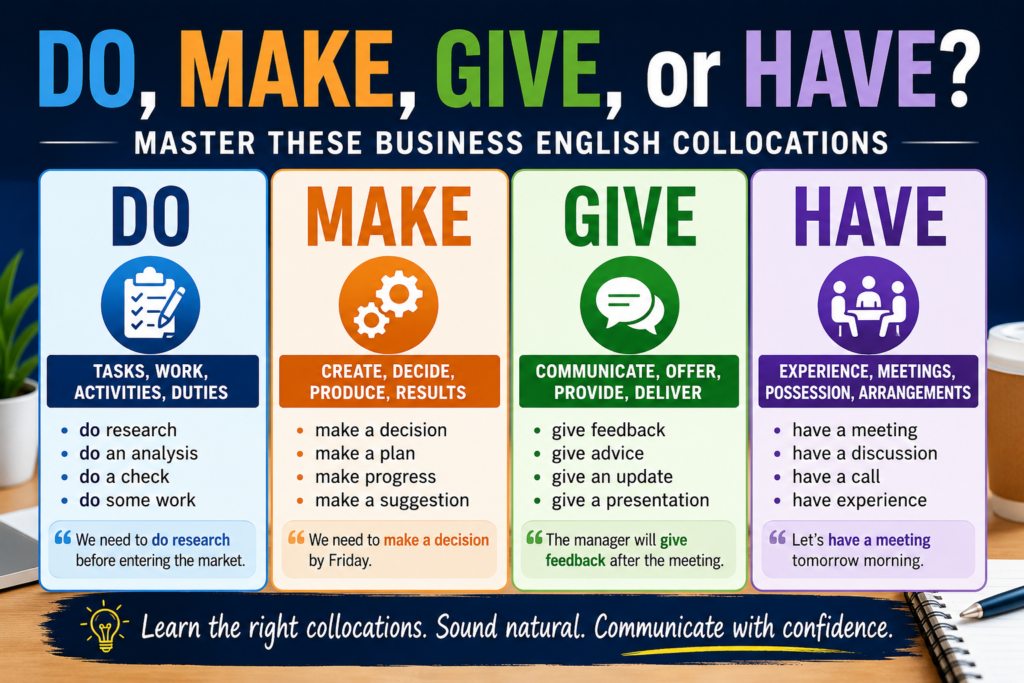
If you have ever wondered whether you should do research, make a decision, give feedback, or have a meeting, you are not alone. Many non-native English get very confused about when to use Do, Make, Give, or Have.
After teaching Business English to students from around the world, I have found that do, make, give, and have are four of the most commonly confused verbs in English. Even advanced learners often use the wrong collocation because the correct combination is different in their native language.
The good news is that there are some simple patterns you can learn. In this article, you’ll discover how to use these four important verbs correctly in business conversations.
What Are Collocations?
A collocation is a natural combination of words that native speakers commonly use together.
For example:
✅ make a decision
❌ do a decision
Although native speakers understand the incorrect version, it sounds unnatural if you don’t use Do, Make, Give, or Have correctly.
Let’s look at each verb in more detail.
DO: Tasks, Work, Activities, Duties
Use do when talking about tasks, work, activities, and responsibilities.
Common DO Collocations
do research
do an analysis
do a check
do the paperwork
do the planning
do business
do some work
do a review
Examples
We need to do research before entering the new market.
The finance team will do an analysis of the sales figures.
Can you do a check on the report before sending it?
I need to do some work this afternoon.
Common Mistakes
❌ make research
✅ do research
❌ make an analysis
✅ do an analysis
❌ make a check
✅ do a check
MAKE: Create, Decide, Produce, Results
Use make when something is created, produced, or decided.
Common MAKE Collocations
make a decision
make a plan
make progress
make a mistake
make a change
make an offer
make a suggestion
make a difference
Examples
We need to make a decision by Friday.
The team has made significant progress this month.
She made a suggestion during the meeting.
The company plans to make several changes next year.
Common Mistakes
❌ have a decision
✅ make a decision
❌ give a suggestion
✅ make a suggestion
❌ do a decision
✅ make a decision
GIVE: Communicate, Offer, Provide, Deliver
Use give when information, advice, support, or communication is transferred to another person.
Common GIVE Collocations
give feedback
give advice
give a presentation
give an update
give support
give guidance
give permission
give information
Examples
The manager will give feedback after the presentation.
Can you give me an update on the project?
She will give a presentation at the conference.
The HR department can give advice on employee benefits.
Common Mistakes
❌ make feedback
✅ give feedback
❌ make advice
✅ give advice
❌ have advice
✅ give advice
HAVE: Experience, Meetings, Possession, Arrangements
Use have when talking about meetings, discussions, conversations, experiences, or possession.
Common HAVE Collocations
- have a meeting
- have a discussion
- have a call
- have a conversation
- have experience
- have concerns
- have a look
- have a solution
Examples Of ‘Have’
Let’s have a meeting tomorrow morning.
We need to have a discussion about the budget.
Can we have a quick call this afternoon?
She has extensive experience in project management.
Common Mistakes Using ‘Make’
❌ make a meeting
✅ have a meeting
❌ make a discussion
✅ have a discussion
❌ give a discussion
✅ have a discussion
A Simple Way to Remember Do, Make, Give, or Have
If you’re unsure about whether to us Do, Make, Give, or Have, remember the following rules:
DO
Tasks, Work, Activities, Duties
MAKE
Create, Decide, Produce, Results
GIVE
Communicate, Offer, Provide, Deliver
HAVE
Experience, Meetings, Possession, Arrangements
Final Thoughts On Do, Make, Give, or Have
Learning collocations with Do, Make, Give, or Have is one of the fastest ways to sound more natural in Business English. Instead of translating directly from your native language, focus on learning common word combinations.
Remember:
- Do = tasks and work
- Make = create and decide
- Give = communicate and provide
- Have = meetings and experiences
Master these four verbs, and you’ll immediately sound more professional and confident in meetings, presentations, emails, and everyday business conversations.