

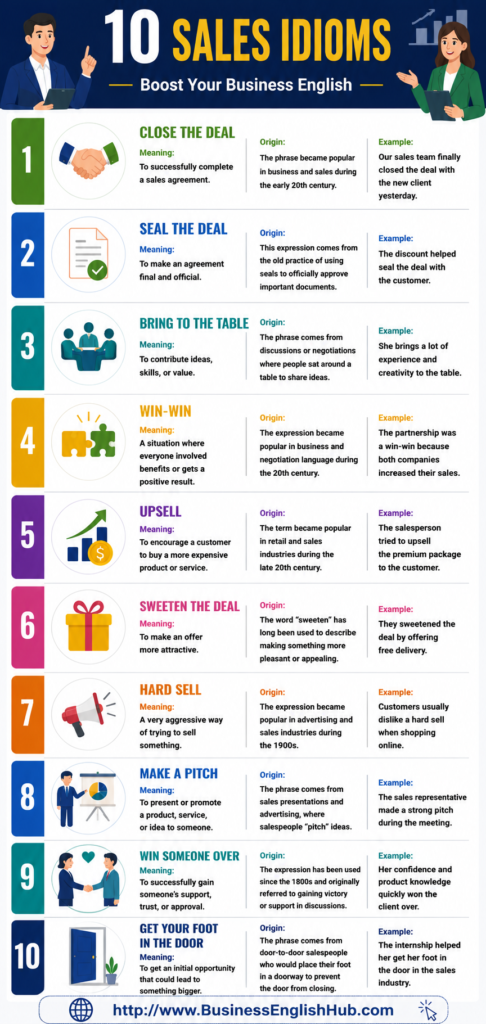
Sales idioms are common expressions used in business conversations, sales meetings, negotiations, and professional communication.
Understanding these idioms can help English learners sound more natural and confident when speaking with clients, customers, coworkers, or managers.
Many native English speakers use sales idioms in everyday business situations without realizing it. Learning these expressions will improve your business English vocabulary, communication skills, and understanding of workplace conversations.
Here are 10 useful sales idioms, along with their meanings, origins, and example sentences.
1. Close the deal
Meaning: To successfully complete a sales agreement.
Origin: The phrase became popular in business and sales during the early 20th century. “Close” means to finish or finalize something.
Example: “Our sales team finally closed the deal with the new client yesterday.”
2. Seal the deal
Meaning: To make an agreement final and official.
Origin: This expression comes from the old practice of using seals or stamps to officially approve important documents.
Example: “The discount helped seal the deal with the customer.”
3. Bring to the table
Meaning: To contribute ideas, skills, or value.
Origin: The phrase comes from discussions or negotiations where people literally sat around a table to share ideas.
Example: “She brings a lot of experience and creativity to the table.”
4. Win-Win
Meaning: A situation where everyone involved benefits or gets a positive result.
Origin: The expression became popular in business and negotiation language during the 20th century. It describes an outcome where both sides “win” instead of one side losing.
Example: “The partnership was a win-win because both companies increased their sales.”
5. Upsell
Meaning: To encourage a customer to buy a more expensive product or service.
Origin: The term became popular in retail and sales industries during the late 20th century.
Example: “The salesperson tried to upsell the premium package to the customer.”
6. Sweeten the deal
Meaning: To make an offer more attractive.
Origin: The word “sweeten” has long been used to describe making something more pleasant or appealing.
Example: “They sweetened the deal by offering free delivery.”
7. Hard sell
Meaning: A very aggressive way of trying to sell something.
Origin: The expression became popular in advertising and sales industries during the 1900s to describe forceful sales techniques.
Example: “Customers usually dislike a hard sell when shopping online.”
8. Make a pitch
Meaning: To present or promote a product, service, or idea to someone.
Origin: The phrase comes from sales presentations and advertising, where salespeople “pitch” ideas to potential customers.
Example: “The sales representative made a strong pitch during the meeting.”
9. Win someone over
Meaning: To successfully gain someone’s support, trust, or approval.
Origin: This expression has been used since the 1800s and originally referred to gaining victory or support in competitions and discussions.
Example: “Her confidence and product knowledge quickly won the client over.”
10. Get your foot in the door
Meaning: To get an initial opportunity that could lead to something bigger.
Origin: This phrase comes from door-to-door salespeople who would place their foot in a doorway to prevent the door from closing.
Example: “The internship helped her get her foot in the door in the sales industry.”
Sales Idioms Conclusion
Sales idioms are an important part of business English and professional communication. These expressions are commonly used in meetings, negotiations, presentations, and conversations with customers or colleagues.
By learning and practicing sales idioms, English learners can improve their confidence, sound more natural, and better understand native English speakers in workplace situations.
The more you hear and use these idioms in real conversations, the easier they will become. Try using one or two sales idioms in your next English conversation and gradually build your business English fluency over time.