

Money idioms are very common in everyday English, business conversations, movies, and TV shows. Learning these expressions can help you sound more natural and understand native speakers more easily.
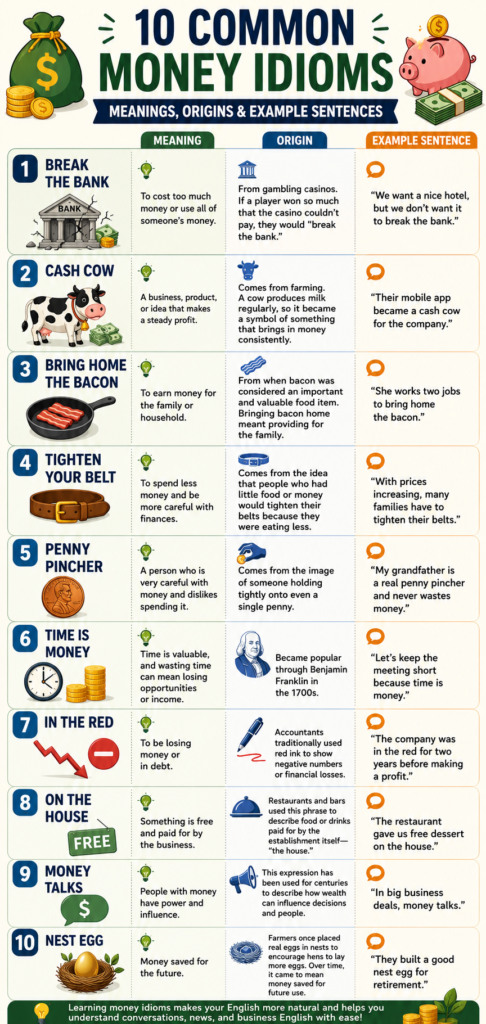
Below are 10 of the most commonly used money idioms, along with their meanings, origins, and example sentences.
1. Break the Bank
Meaning
To cost too much money or use all of someone’s money.
Origin
This idiom comes from gambling casinos. If a player won so much money that the casino could not continue paying, they would “break the bank.”
Example Sentence
We want a nice hotel, but we don’t want it to break the bank.
2. Cash Cow
Meaning
A business, product, or idea that makes a steady profit.
Origin
The expression comes from farming. A cow produces milk regularly, so it became a symbol of something that continuously provides income.
Example Sentence
Their mobile app became a cash cow for the company.
3. Bring Home the Bacon
Meaning
To earn money for the family or household.
Origin
This phrase dates back many years when bacon was considered an important and valuable food item. Bringing bacon home meant providing for the family.
Example Sentence
She works two jobs to bring home the bacon.
4. Tighten Your Belt
Meaning
To spend less money and be more careful with finances.
Origin
This idiom comes from the idea that people who had little food or money would tighten their belts because they were eating less.
Example Sentence
With prices increasing, many families have to tighten their belts.
5. Penny Pincher
Meaning
A person who is very careful with money and dislikes spending it.
Origin
The phrase comes from the image of someone holding tightly onto even a single penny.
Example Sentence
My friend is a real penny pincher and never wastes money.
6. Time is Money
Meaning
Time is valuable, and wasting time can mean losing opportunities or income.
Origin
This phrase became popular through Benjamin Franklin in the 1700s.
Example Sentence
Let’s keep the meeting short because time is money.
7. In the Red
Meaning
To be losing money or in debt.
Origin
Accountants traditionally used red ink to show negative numbers or financial losses.
Example Sentence
The company was in the red for two years before making a profit.
8. On the House
Meaning
Something is free and paid for by the business.
Origin
Restaurants and bars used this phrase to describe food or drinks paid for by the establishment itself — “the house.”
Example Sentence
The restaurant gave us free dessert on the house.
9. Money Talks
Meaning
People with money have power and influence.
Origin
This expression has been used for centuries to describe how wealth can influence decisions and people.
Example Sentence
In big business deals, money talks.
10. Nest Egg
Meaning
Money saved for the future.
Origin
Farmers once placed real eggs in nests to encourage hens to lay more eggs. Over time, the phrase came to mean money kept safely for future use.
Example Sentence
They built a good nest egg for retirement.
Final Thoughts About Money Idioms
Money idioms are useful in both everyday and business English. Expressions like “break the bank,” “cash cow,” and “in the red” are commonly used in meetings, conversations, news reports, and daily life.
By learning these idioms, you can:
- Sound more natural in English
- Improve your business vocabulary
- Understand movies, TV shows, and native speakers more easily
- Communicate more confidently at work and while travelling
Try using one or two of these idioms in your next English conversation to help them become part of your active vocabulary.