

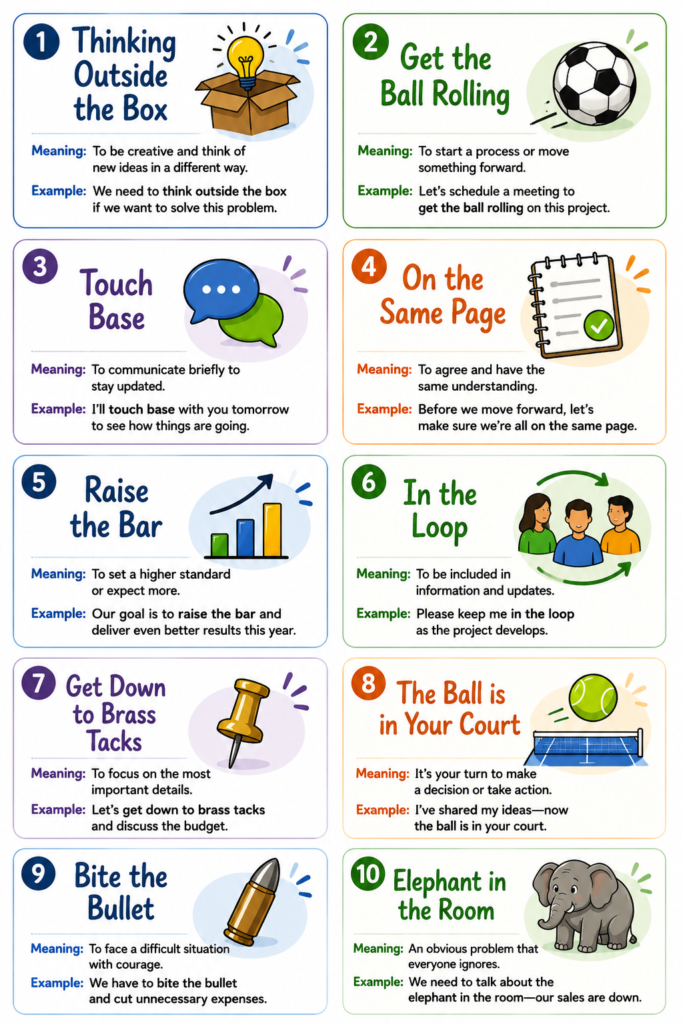
‘Thinking Outside the Box’
The idiom ‘thinking outside the box’ is often used in professional settings to encourage creative and innovative thought processes. This expression implies that the individuals involved should break away from conventional solutions and explore alternative approaches. In essence, it is a call to disregard traditional boundaries and to approach problems with a fresh perspective. By emphasizing creativity and originality, the phrase advocates for the generation of novel ideas that can effectively address challenges.
The origin of this idiom can be traced back to a puzzle from the 1980s, wherein participants were tasked with connecting a set of dots located within a square, using a limited number of straight lines. The crux of the challenge lay in the fact that the solution required extending the lines beyond the confines of the square, which symbolically represents the box. Therefore, engaging in ‘thinking outside the box’ encourages individuals and teams to look beyond the obvious and to venture into new territory when seeking solutions.
In practical application, the phrase can resonate in various business meetings, particularly during brainstorming sessions. For instance, if the group is facing a significant sales challenge, a team leader might assert, “To solve the sales issue, we need to start thinking outside the box.” This statement serves not only as a motivational push but also acts as a reminder to explore imaginative solutions that may not have been previously considered. Embracing this mindset can often lead to breakthroughs that drive progress and innovation within an organization.
2. Get the Ball Rolling
The idiom ‘get the ball rolling’ is commonly used in meetings to signify the initiation of a process or action. It brings emphasis to the essential first step in any undertaking, which is crucial to gather momentum and drive a project forward. This phrase suggests that once some form of action is taken, it can lead to increased activity and progress, much like the physical act of rolling a ball that relies on an initial push to gain speed and movement.
In various professional settings, it is often articulated as, “Let’s get the ball rolling on this project so we can meet our deadlines”. Here, the phrase captures the urgency associated with starting projects efficiently, demonstrating that early engagement can facilitate a smoother workflow. The context in which this idiom is employed often underscores the necessity for quick decision-making and collaboration among team members to ensure that tasks are not delayed.
The origin of this idiom can be traced back to the practice of rolling a large ball in sporting games. Traditionally, this action signifies the commencement of play and establishes an atmosphere of participation. Over time, ‘get the ball rolling’ has transcended its literal meaning and found a place in the corporate vernacular, symbolizing proactive behavior and the pursuit of deadlines.
Using this phrase not only serves to motivate teams but also highlights the importance of initiating discussions and actionable items in a meeting. It emphasizes that to achieve objectives, it is vital not to linger on planning alone, but rather to take the leap to start the actual work.
3. Touch Base
The idiom ‘touch base’ is often encountered in the professional environment, especially during meetings. To ‘touch base’ primarily signifies the act of making contact or checking in with someone to discuss a specific topic or ensure that everyone is on the same page regarding a project or task. It emphasizes the need for brief discussions that promotes alignment and fosters open communication among team members.
This phrase is frequently employed in various professional settings to facilitate progress updates or to clarify any outstanding concerns. For instance, a manager may suggest, “Let’s touch base tomorrow to discuss the proposal,” indicating the need to reconnect and share thoughts about the proposal’s status and next steps. The straightforwardness of this expression reflects its effectiveness in promoting teamwork and understanding. Such short, purposeful meetings help to eliminate potential misunderstandings and keep everyone focused on their respective roles.
The origins of the term can be traced back to the game of baseball, where players are required to touch the bases while running. In essence, just as players check in at strategic points in the game, business professionals use this idiom to metaphorically ‘touch base’ with colleagues or stakeholders in a structured environment. This makes it an ideal phrase for conveying the importance of brief communications in the business world.
In effect, ‘touch base’ serves as a vital tool for enhancing collaboration and ensuring that all team members remain informed about ongoing developments. Its frequent usage in meetings serves a crucial role in maintaining clarity and focus in collaborative endeavors.
4. On the Same Page
The idiom “on the same page” is widely employed in meetings to indicate a state of shared understanding and consensus among participants. It emphasizes the necessity for all attendees to have the same knowledge or viewpoints regarding the subject matter at hand. This expression is often invoked to ensure clarity before progressing with discussions or decision-making processes. For instance, a facilitator might say, “Before we move forward, let’s make sure we’re all on the same page,” which ensures that each participant is aligned and aware of the information being discussed.
The use of this phrase underscores the importance of effective communication in collaborative environments. When team members are “on the same page,” it fosters an atmosphere conducive to productive dialogue and reduces the likelihood of misunderstandings. This alignment is crucial in various contexts, such as project planning, problem-solving, or strategy formulation, where differing interpretations or expectations can lead to conflict or confusion.
Historically, the phrase originated in literary contexts, where it referred to ensuring that all readers were referencing the same section or chapter of text during a discussion. Although its origins may stem from written communication, its application has become increasingly relevant in verbal exchanges and business interactions. By invoking the notion of being “on the same page,” meeting participants can effectively reaffirm their commitment to mutual understanding, thereby enhancing collaboration and teamwork.
In conclusion, the expression “on the same page” serves as a vital piece of communication strategy in meetings. It aids in ensuring that all individuals are equipped with the same information and perspectives, ultimately leading to more effective outcomes and decision-making.
5. Raise the Bar
The idiom “raise the bar” is frequently utilized in professional settings, particularly in meetings where setting high expectations or standards becomes paramount. To “raise the bar” essentially means to elevate performance levels and to challenge individuals or teams to achieve more than they previously thought possible. This phrase can be a powerful motivator, encouraging teams to strive toward excellence in their objectives.
In a business context, using the phrase “raise the bar” might be appropriate when discussing strategic initiatives or performance targets. For instance, one might say, “We need to raise the bar if we want to outshine our competitors this quarter.” This indicates a need to improve performance beyond the current benchmarks or standards, thereby fostering an environment of growth and ambition among team members.
Tracing the origins of the idiom reveals its roots in the world of athletics, specifically in sports like high jump. In these sports, competitors must clear a bar set at a certain height to succeed. As they improve, the height of the bar is raised, signifying the need for greater skill and effort to achieve success. Thus, the term has been adopted into business vernacular to symbolize the constant push for improvement and the necessity of rising to new challenges.
Ultimately, incorporating the phrase “raise the bar” in meetings can serve as a rallying cry for innovation and progress, reinforcing the idea that continuous improvement should be a key goal within the organization. It not only emphasizes the importance of high expectations but also promotes a culture where striving for excellence is recognized and valued.
6. In the Loop
Staying ‘in the loop’ is an idiom frequently encountered in professional meetings, signifying the importance of being kept informed about ongoing developments and critical updates. This phrase is often used when members of a team want to ensure that they are aware of relevant information, allowing them to contribute effectively during discussions and decision-making processes.
The metaphorical concept of a ‘loop’ illustrates the process of communication within a team, where information continuously circulates among members. To remain ‘in the loop’ is essential for maintaining awareness of changes, thus enhancing collaboration and fostering a culture of transparency within the workplace. When individuals do not have access to essential updates, it may lead to misalignment, confusion, and ineffective communication.
For instance, a project manager might say, ‘Please keep me in the loop on any updates regarding the project,’ indicating a desire to stay informed of all developments as they occur. This ensures that any necessary actions can be taken promptly and that everyone is on the same page, preventing oversights that could negatively impact project timelines and outcomes.
Moreover, being ‘in the loop’ signifies a level of inclusivity where team members feel valued and recognized for their contributions. It encourages proactive engagement and allows for collaborative problem-solving. Moreover, it reflects an organization’s commitment to effective communication and information sharing, which is vital in today’s fast-paced business environments.
7. Get Down to Brass Tacks
The idiom “get down to brass tacks” signifies the importance of focusing on the essential aspects of a discussion or meeting. This phrase is often employed when participants feel that preliminary conversations have deviated from the core issues at hand. It serves as a reminder to attendees that it is time to transition from the broader topics to the specific matters that need resolution. For instance, one might say, “Let’s get down to brass tacks and figure out our budget,” which illustrates a shift in focus to the financial components of a project that require immediate attention.
The origin of this phrase is somewhat murky, with various theories suggesting its roots in different contexts. Some believe it may derive from the construction industry, where brass tacks were used as a method to provide precise measurements. Others argue it could point to the use of brass tacks in upholstery, where they hold important elements together. Regardless of its source, the phrase has found a place in business and everyday conversations to denote a direct approach toward addressing critical matters.
In a business setting, using this idiom can help convey a sense of urgency or necessity, prompting team members to prioritize tasks that impact project timelines or budget considerations. By encouraging individuals to “get down to brass tacks,” leaders foster an environment where dialogue is structured and meaningful, facilitating more effective decision-making processes. Ultimately, employing this expression not only clarifies intentions but also enhances the overall productivity of meetings.
8. The Ball is in Your Court
The idiom “the ball is in your court” is often employed in professional settings, particularly during meetings, to indicate that it is another person’s turn to make a decision or take action. This phrase conveys a sense of accountability, emphasizing that the responsibility now lies with the individual being addressed. In essence, following a discussion or presentation, when someone states, “the ball is in your court,” they are suggesting that they have done all they can and are now awaiting the other party’s response.
The phrase has its origins in the world of tennis, whereby a player must return the ball to their opponent after it has been served. The concept highlights that play continues based on the actions of the player receiving the ball. Similarly, in a meeting context, this idiom can signal the point in a dialogue where one party has successfully conveyed their insights or proposals, thus placing the onus on another participant to engage with those ideas, offer feedback, or make a final decision.
Using this idiom in meetings can foster clarity in communication. For instance, if a team has made its recommendations regarding a project, conveying that “the ball is in your court” directly prompts stakeholders to reflect on the proposals and determines the next steps of the process. Utilizing this expression not only articulates a waiting period for a response but also establishes an expectation of action from those involved.
Overall, understanding the meaning behind idioms like “the ball is in your court” adds depth to professional conversations, enhancing clarity around decision-making dynamics within team collaborations. In future meetings, consider how such phrases can succinctly convey complex ideas and facilitate constructive dialogue.
9. Bite the Bullet
The idiom “bite the bullet” is commonly used in professional settings, particularly during meetings, to denote the act of facing a difficult or unpleasant situation with bravery and determination. This expression is often invoked when a team must make a hard decision, such as implementing budget cuts, changing a strategy, or addressing a conflict. For example, a manager might state, “We need to bite the bullet and cut costs, even if it’s hard,” thereby underscoring the necessity of confronting challenges head-on.
The origin of the phrase is rooted in historical medical practices where soldiers and patients, unable to receive anesthesia, were asked to bite down on a bullet during painful procedures. This act not only symbolized courage but also the acceptance of unavoidable pain. In today’s business terminology, the phrase has evolved to encompass a range of scenarios where decisive action is required despite inherent difficulties.
Incorporating this idiom in meetings can serve to motivate team members. By framing a challenging issue in this manner, leaders can foster a sense of camaraderie and resilience among colleagues, emphasizing that facing hardship is a part of the growth process. Furthermore, it illustrates a proactive approach to problem-solving, encouraging participants to consider ways to move forward despite obstacles.
In conclusion, “bite the bullet” not only captures the essence of facing challenges in the workplace but also serves as a rallying cry for teams navigating complex decisions. Understanding and using this phrase can enhance communication during meetings, paving the way for more effective collaboration and resolution of tough issues.
10. ‘Elephant in the Room’
The idiom ‘elephant in the room’ refers to a significant issue or problem that is obvious but is deliberately ignored or avoided in discussion. This expression serves as a metaphor for unaddressed problems that can create discomfort or tension within a group. Recognizing the elephant in the room means acknowledging these substantial subjects that require attention, often because they may provoke uncomfortable conversations.
The origins of this phrase are not definitively traced, but it is believed to encapsulate the discomfort associated with large, unresolved issues that loom over an organization or a meeting. This idiom is particularly relevant in meetings where difficult topics need to be discussed, yet participants may choose to sidestep them to maintain a sense of politeness or to avoid confrontation.
For instance, consider a sales meeting where the team is aware of dwindling revenues but continues to focus on minor operational details without addressing the core issue. A participant might say, ‘Let’s not ignore the elephant in the room; we need to address our declining sales.’ This statement invites attendees to confront the underlying challenge rather than glossing over it.
By addressing the elephant in the room, organizations can foster a culture of transparency, encouraging team members to speak openly about pressing matters that affect overall productivity and morale. Ultimately, acknowledging and confronting significant issues can lead to more effective solutions and stronger collaborations, enhancing the quality of team dynamics and decision-making processes.