

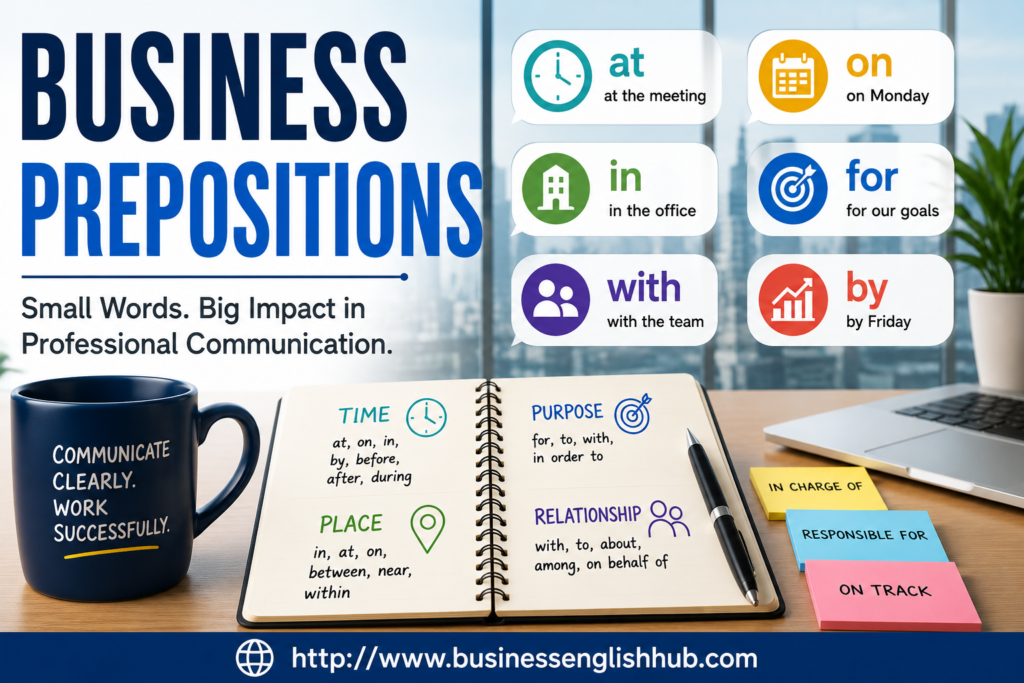
If you want to communicate more clearly and professionally at work, learning business prepositions is essential.
Prepositions are small words such as at, on, in, by, and with, but they play a big role in business communication. Using the wrong preposition can make your English sound unnatural or even change the meaning of your message.
Whether you’re attending meetings, writing emails, speaking with clients, or giving presentations, understanding business prepositions will help you sound more confident and professional.
In this guide, we’ll look at some of the most common business prepositions and how they are used in real workplace situations.
1. Prepositions of Time in Business
Business professionals frequently discuss schedules, deadlines, and meetings. These prepositions help describe time. Here are some examples:
at – The meeting starts at 9 a.m.
on – The deadline is on Friday.
in – The project will finish in Q2.
by – Please send the report by tomorrow.
before – Let’s review the contract before signing.
after – We’ll discuss this after the call.
during – She asked several questions during the presentation.
until / till – The offer is valid until the end of the month.
within – We aim to respond within 24 hours.
2. Prepositions of Place & Position (Office / Work)
in – He works in the finance department.
at – She is at head office today.
on – The HR team is on the third floor.
between – There is strong cooperation between the teams.
among – The issue was discussed among senior managers.
behind – We are behind schedule due to delays.
next to – My desk is next to the sales team.
near – The client’s office is near the airport.
within – This policy applies within the organisation.
3. Prepositions of Cause, Reason & Purpose
because of – The launch was delayed because of supply issues.
due to – The error occurred due to miscommunication.
for – This training is for new employees.
from – The problem resulted from poor planning.
to – We hired a consultant to improve efficiency.
with – The changes were made with growth in mind.
4. Prepositions Used in Business Collocations
in – She is in charge of operations.
on – The project is on track.
of – He is a member of the board.
for – They are responsible for customer support.
with – We agree with your proposal.
about – Let’s talk about the budget.
5. Prepositions for Communication & Interaction
with – I met with the client yesterday.
to – She spoke to her manager about the issue.
about – He sent an email about the contract.
on – We had a discussion on strategy.
via – The update was shared via Zoom.
6. Prepositions of Movement & Change (Business Processes)
into – The company expanded into new markets.
from – He moved from sales to marketing.
to – Profits increased to 15% this year.
towards – The team is working towards a solution.
out of – We are running out of time.
7. Common Business Prepositional Phrases
in terms of – In terms of cost, this option is better.
on behalf of – She signed the agreement on behalf of the company.
in accordance with – The process was completed in accordance with policy.
at risk of – The project is at risk of failure.
under pressure – The team is under pressure to deliver results.
in compliance with – We operate in compliance with regulations.
Common Mistakes with Business Prepositions
Incorrect:
- Responsible of the project
- Discuss about the issue
- Agree to someone
Correct:
- Responsible for the project
- Discuss the issue
- Agree with someone
Learning these common combinations will help you sound more natural and professional.
Final thoughts on Business Prepositions
Mastering business prepositions is one of the easiest ways to improve your professional English. These small words appear in emails, meetings, presentations, reports, and conversations every day.
By learning common business prepositions and practising them in context, you’ll communicate more clearly, avoid common mistakes, and sound more confident in the workplace.
Start by focusing on the most common combinations such as responsible for, in charge of, agree with, on track, and on behalf of.
With regular practice, using business prepositions correctly will become second nature and help you succeed in international business environments.