

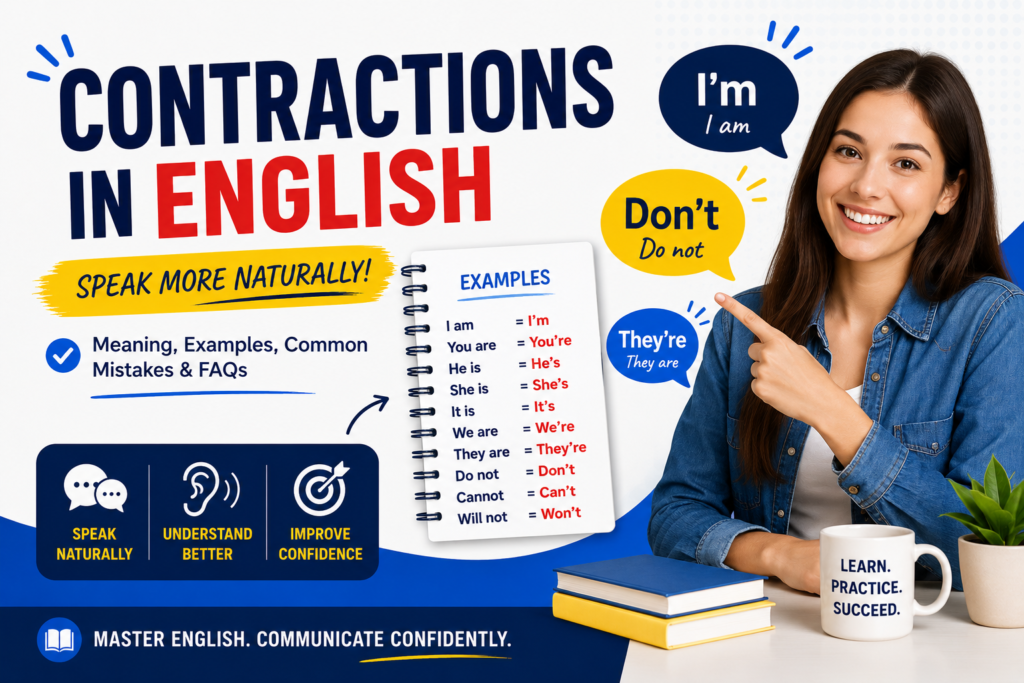
If you want to sound more natural when speaking English, you need to learn contractions in English.
Native speakers use contractions every day in conversations, emails, text messages, meetings, and social situations. Understanding contractions will help you improve your listening skills, speaking fluency, and confidence.
In this guide, you’ll learn what contractions are, how to use them, common examples, and answers to the most frequently asked questions English learners have about contractions.
What Are Contractions in English?
A contraction is a shortened form of two words.
An apostrophe (‘) replaces one or more missing letters.
Examples
| Full Form | Contraction |
|---|
| I am | I’m |
| You are | You’re |
| He is | He’s |
| She is | She’s |
| It is | It’s |
| We are | We’re |
| They are | They’re |
| Do not | Don’t |
| Cannot | Can’t |
| Will not | Won’t |
Example Sentences
I’m happy to help.
You’re doing a great job.
She’s working from home today.
They’re waiting for the meeting to start.
Don’t worry about it.
We can’t attend the event.
Why Do People Use Contractions?
Contractions make English sound more natural and conversational.
Compare these sentences:
Without Contractions
I am going to the office.
We are happy to meet you.
They will not be late.
With Contractions
- I’m going to the office.
- We’re happy to meet you.
- They won’t be late.
The second group sounds more natural in everyday English.
Most Common Contractions in English
Contractions with “Be”
| Full Form | Contraction |
| I am | I’m |
| You are | You’re |
| He is | He’s |
| She is | She’s |
| It is | It’s |
| We are | We’re |
| They are | They’re |
Examples
It’s a beautiful day.
We’re ready to begin.
She’s studying English.
Contractions with “Have”
| Full Form | Contraction |
| I have | I’ve |
| You have | You’ve |
| We have | We’ve |
| They have | They’ve |
Examples
I’ve finished the report.
You’ve done a great job.
They’ve already arrived.
Contractions with “Will”
| Full Form | Contraction |
| I will | I’ll |
| You will | You’ll |
| He will | He’ll |
| She will | She’ll |
| We will | We’ll |
| They will | They’ll |
Examples
I’ll call you tomorrow.
We’ll discuss it later.
They’ll arrive soon.
Negative Contractions
| Full Form | Contraction |
| Do not | Don’t |
| Does not | Doesn’t |
| Did not | Didn’t |
| Is not | Isn’t |
| Are not | Aren’t |
| Was not | Wasn’t |
| Were not | Weren’t |
| Cannot | Can’t |
| Will not | Won’t |
| Would not | Wouldn’t |
Examples
I don’t understand.
She isn’t available today.
We can’t find the document.
They won’t attend the meeting.
Common Contraction Mistakes
1. Its vs It’s
Many learners confuse these words.
It’s
This means:
- It is
- It has
Example:
- It’s raining.
- It’s been a long day.
Its
Shows possession.
Example:
- The company changed its logo.
- The dog wagged its tail.
2. They’re vs Their vs There
They’re
= They are
Example:
- They’re working late.
Their
Shows possession.
Example:
- Their office is nearby.
There
Shows a place.
Example:
- The meeting is over there.
3. You’re vs Your
You’re
= You are
Example:
- You’re doing well.
Your
Shows possession.
Example:
- Your English is improving.
Frequently Asked Questions About Contractions
Are contractions grammar?
Yes.
Contractions are a normal part of English grammar. Native speakers use them every day.
Should I use contractions in speaking?
Absolutely.
Using contractions makes your English sound more natural and fluent.
For example:
Instead of:
“I am happy to meet you.”
Most native speakers say:
“I’m happy to meet you.”
Should I use contractions in writing?
Usually yes.
Contractions are common in:
- Emails
- Blogs
- Social media
- Text messages
- Informal business communication
However, contractions are often avoided in:
- Academic essays
- Legal documents
- Formal reports
Why are contractions difficult to hear?
Native speakers speak quickly.
For example:
“I’ll see you later.”
may sound like:
“Ahl see ya later.”
Learning contractions helps improve listening comprehension because you’ll hear them constantly in real conversations.
Can I use contractions in business English?
Yes.
Most modern business communication uses contractions.
Examples:
- We’re pleased to confirm your order.
- I’ve attached the document.
- We’ll contact you shortly.
- Don’t hesitate to ask questions.
Using contractions often sounds friendlier and more natural.
Which contractions should I learn first?
Start with these:
- I’m
- You’re
- He’s
- She’s
- It’s
- We’re
- They’re
- I’ve
- We’ll
- Don’t
- Can’t
- Won’t
These are the contractions you’ll hear most often in everyday English.
Final Thoughts on Contractions in English
Contractions in English are an important part of natural communication. They help native English speakers talk faster and make conversations sound smoother and more relaxed.
Remember:
- I’m = I am
- You’re = You are
- It’s = It is / It has
- Don’t = Do not
- Can’t = Cannot
- We’ll = We will
The more contractions you use correctly, the more confident and natural your English will sound.