

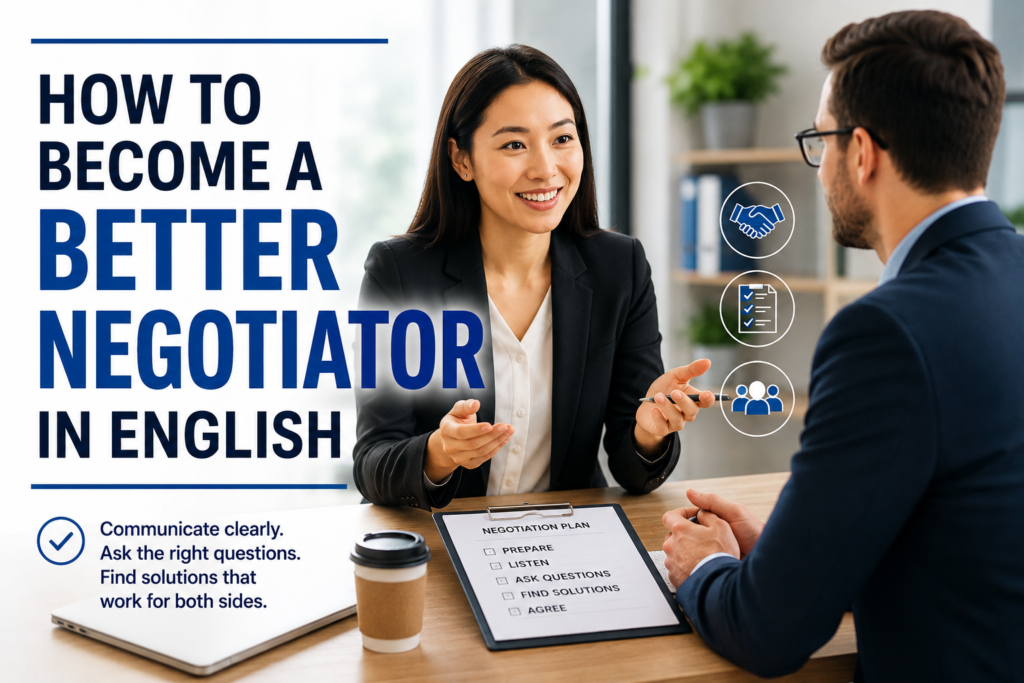
Negotiating can be difficult in any language. When you need to negotiate in English, it can be even more challenging, but there are easy ways to become a better negotiator.
You may need to negotiate a salary, agree on a price, discuss a contract, arrange a deadline, or find a solution to a problem. You need to understand the other person, explain your position clearly, ask the right questions, and sometimes disagree politely.
The good news is that you do not need perfect English to negotiate successfully. You need clear communication, useful vocabulary, good listening skills, and the confidence to take your time.
In this guide, you will learn practical ways to become a better negotiator in English.
What Does “Negotiate” Mean?
To negotiate means to discuss something with another person or group to try to reach an agreement.
For example:
- Two companies negotiate the price of a product.
- An employee negotiates their salary.
- A customer negotiates a better deal.
- A manager negotiates a deadline with a client.
- A buyer and seller negotiate the terms of a contract.
The noun is negotiation.
Example:
“The negotiation lasted for two hours.”
A negotiator is a person who takes part in a negotiation.
Example:
“She is a confident and experienced negotiator.”
Why Is Negotiating in English Difficult?
Negotiating requires more than knowing vocabulary.
You need to listen carefully, respond quickly, ask questions, explain your position, and understand what the other person really wants.
When English is not your first language, you may also worry about making grammatical mistakes or misunderstanding something important.
However, good negotiation is not about using complicated English. In fact, simple and direct language is often more effective.
Instead of trying to sound advanced, concentrate on being clear, calm, polite, and precise.
1. Prepare Your English Before the Negotiation
Preparation is one of the best ways to become a better negotiator in English.
Before an important negotiation, think about the vocabulary and phrases you are likely to need.
For example, if you are negotiating a contract, you might prepare words such as:
- contract
- terms
- conditions
- deadline
- payment
- price
- discount
- delivery
- agreement
- compromise
Also prepare some important numbers, dates, prices, names, and technical terms.
If you know what you want to say before the meeting begins, you will feel more confident.
2. Know What You Want
Before you start negotiating, ask yourself some simple questions:
- What do I want?
- What is most important to me?
- What can I accept?
- Where can I compromise?
- What can’t I accept?
- What does the other person probably want?
For example, imagine you are buying products from a supplier.
You want a lower price, but the supplier does not want to reduce it.
However, the supplier might offer free delivery instead.
A successful negotiation does not always mean getting everything you originally wanted. Sometimes, it means finding a solution that works for both sides.
3. Start the Negotiation Positively
Try to create a friendly and professional atmosphere at the beginning.
You could say:
- “Thank you for meeting with us.”
- “It’s good to speak with you again.”
- “We’re looking forward to discussing this.”
- “Hopefully, we can find a solution that works for everyone.”
- “I’d like to start by discussing the main points.”
A positive beginning can make difficult discussions easier later.
4. Ask Plenty of Questions
Good negotiators do not spend the entire conversation talking.
They ask questions.
Questions help you discover what the other person wants and what they may be willing to change.
Useful questions include:
- “What are you looking for?”
- “What’s most important to you?”
- “Would you consider a lower price?”
- “How flexible are you on the delivery date?”
- “What would you suggest?”
- “Is there any flexibility on that?”
- “What if we increased the order?”
Open questions can be particularly useful because they encourage the other person to give you more information.
For example:
Closed question:
“Can you reduce the price?”
Open question:
“What flexibility do you have on the price?”
The second question may give you more useful information.
5. Learn How to Make an Offer
Making offers is an important part of negotiating.
Here are some useful expressions:
- “We can offer €5,000.”
- “We’d be prepared to offer…”
- “How about €5,000?”
- “We could agree to that if…”
- “We’d be willing to…”
- “Our best offer would be…”
- “What if we…?”
Using could and would can make your English sound softer and more diplomatic.
Compare:
Direct:
“Reduce the price by 10%.”
More diplomatic:
“Would you be able to reduce the price by 10%?”
Both sentences communicate the same basic idea, but the second is usually more suitable for a professional negotiation.
6. Learn to Disagree Politely
You will not agree with everything during a negotiation.
However, disagreement does not need to become an argument.
Instead of saying:
“No. That’s too expensive.”
You could say:
“I’m afraid that’s a little higher than we expected.”
Other useful phrases include:
- “I understand your position, but…”
- “I see your point. However…”
- “I’m not sure we could agree to that.”
- “That could be difficult for us.”
- “I’m afraid that wouldn’t work for us.”
- “We may need to look at another option.”
- “Could we consider an alternative?”
These phrases allow you to disagree while keeping the conversation professional.
7. Use Conditional Language
Conditional sentences are extremely useful in negotiations because they allow you to connect one offer to another.
For example:
“If you reduce the price, we can increase our order.”
This means that you will do something if the other person does something in return.
Other examples include:
- “If you can deliver by Friday, we can confirm the order today.”
- “If we agreed to that price, could you include delivery?”
- “We could extend the contract if you offered us a better rate.”
- “If you increased the order, we could offer a discount.”
This type of language is useful for finding compromises.
8. Don’t Be Afraid to Ask for Clarification
One of the biggest mistakes English learners can make is pretending to understand something when they do not.
In a negotiation, a small misunderstanding can become an expensive mistake.
If you don’t understand something, ask.
You can say:
- “Could you explain that again, please?”
- “Could you clarify what you mean by that?”
- “Sorry, could you say that again?”
- “When you say ‘flexible,’ what exactly do you mean?”
- “Could you give me an example?”
- “Just to make sure I’ve understood correctly…”
Asking for clarification is not a sign of poor English. In professional communication, it can demonstrate that you are paying attention and want to avoid misunderstandings.
9. Confirm Important Information
Do not assume that both sides have understood an agreement in exactly the same way.
Summarise important points.
For example:
“So, just to confirm, you’re offering a 10% discount if we order 500 units.”
You could also say:
- “Let me make sure I’ve understood correctly.”
- “So we’ve agreed that…”
- “Just to confirm…”
- “My understanding is that…”
- “Can we confirm the final price?”
- “Let’s go over what we’ve agreed.”
This is especially important when discussing money, quantities, deadlines, responsibilities, or contract terms.
10. Listen More Carefully
Listening is one of the most important negotiation skills.
Do not spend all your time thinking about what you are going to say next.
Listen for information that may help you.
For example, a supplier might say:
“We can’t reduce the price on small orders.”
The important words here are “small orders.”
You could respond:
“What if we increased the size of the order?”
Good negotiators listen for opportunities like this.
11. Don’t Be Afraid of Silence
You do not have to answer immediately.
This is particularly important when negotiating in a second language.
If someone makes an offer, you can take a few seconds to think.
You can also use phrases such as:
- “Let me think about that.”
- “Give me a moment to consider that.”
- “I’d like to think about that before answering.”
- “Can we come back to that point?”
- “I’d like some time to consider your proposal.”
Speaking slowly and carefully can be better than speaking quickly and making an agreement you do not fully understand.
12. Learn Common Negotiation Vocabulary
Here are some useful words and expressions to learn:
| Word/Phrase | Meaning | Example |
|---|
| offer | A proposal made during a negotiation | “That’s an interesting offer.” |
| counteroffer | A different offer made in response | “We’d like to make a counteroffer.” |
| compromise | An agreement where both sides make changes | “We need to find a compromise.” |
| terms | The conditions of an agreement | “We’re happy with the terms.” |
| deal | An agreement | “I think we have a deal.” |
| discount | A reduction in price | “Can you offer a discount?” |
| flexible | Willing or able to change | “We’re flexible on the delivery date.” |
| proposal | A suggested plan or offer | “We’ll consider your proposal.” |
| bottom line | The most important point or minimum acceptable position | “The price is our bottom line.” |
| meet halfway | Both sides compromise | “Perhaps we could meet halfway.” |
13. Use “Win-Win” Thinking
A good negotiation does not always need one winner and one loser.
In business, the best agreements often benefit both sides.
This is sometimes called a win-win situation.
For example, imagine a customer wants a lower price and the supplier wants a larger order.
They might agree:
Customer: “If we order 1,000 units, could you give us a 10% discount?”
Supplier: “We could offer 8% for an order of 1,000 units.”
Customer: “Could you make it 10% if we sign a 12-month contract?”
Supplier: “Yes, we could agree to that.”
Both sides receive something valuable.
14. Practise Negotiating Out Loud
Reading negotiation vocabulary is useful, but speaking practice is even more important.
Choose a situation and practise it aloud.
For example:
Situation: You want a better price from a supplier.
Practise saying:
“We’re happy with the product, but the price is a little higher than we expected. Is there any flexibility?”
Then imagine the supplier says no.
How would you respond?
You might say:
“I understand. What if we increased the size of our order?”
Practising situations like this helps useful phrases become more automatic.
15. Learn From Real Negotiations
After a negotiation in English, spend a few minutes reviewing it.
Ask yourself:
- What did I say well?
- What was difficult to understand?
- Which words didn’t I know?
- Did I ask enough questions?
- Did I explain my position clearly?
- Did I understand the final agreement?
- What could I say differently next time?
Write down new vocabulary and useful phrases.
Every negotiation can become an English lesson.
Useful English Negotiation Phrases
Here is a quick list you can practise.
Making an offer:
- “We’d like to offer…”
- “How about…?”
- “We could offer…”
- “Would you consider…?”
Disagreeing:
- “I understand your position, but…”
- “I’m afraid that wouldn’t work for us.”
- “That’s a little higher than we expected.”
Compromising:
- “Perhaps we could meet halfway.”
- “We could agree to that if…”
- “What if we…?”
- “Is there any flexibility?”
Clarifying:
- “Could you clarify that?”
- “What exactly do you mean?”
- “Just to make sure I’ve understood…”
Reaching an agreement:
- “That works for us.”
- “I think we have a deal.”
- “So, we’ve agreed that…”
- “Let’s confirm the final details.”
Final Thoughts: How To Become A Better Negotiator In English
Becoming a better negotiator in English takes practice, but you do not need perfect grammar or advanced vocabulary.
Concentrate on communicating clearly.
Prepare before important negotiations, ask questions, listen carefully, learn how to disagree politely, and confirm important details before reaching an agreement.
Most importantly, do not be afraid to slow the conversation down when necessary.
A successful negotiator is not necessarily the person who speaks the most English. It is the person who listens carefully, communicates clearly, asks good questions, and works towards a useful agreement.
With regular practice, you can improve both your negotiation skills and your confidence communicating professionally in English.